
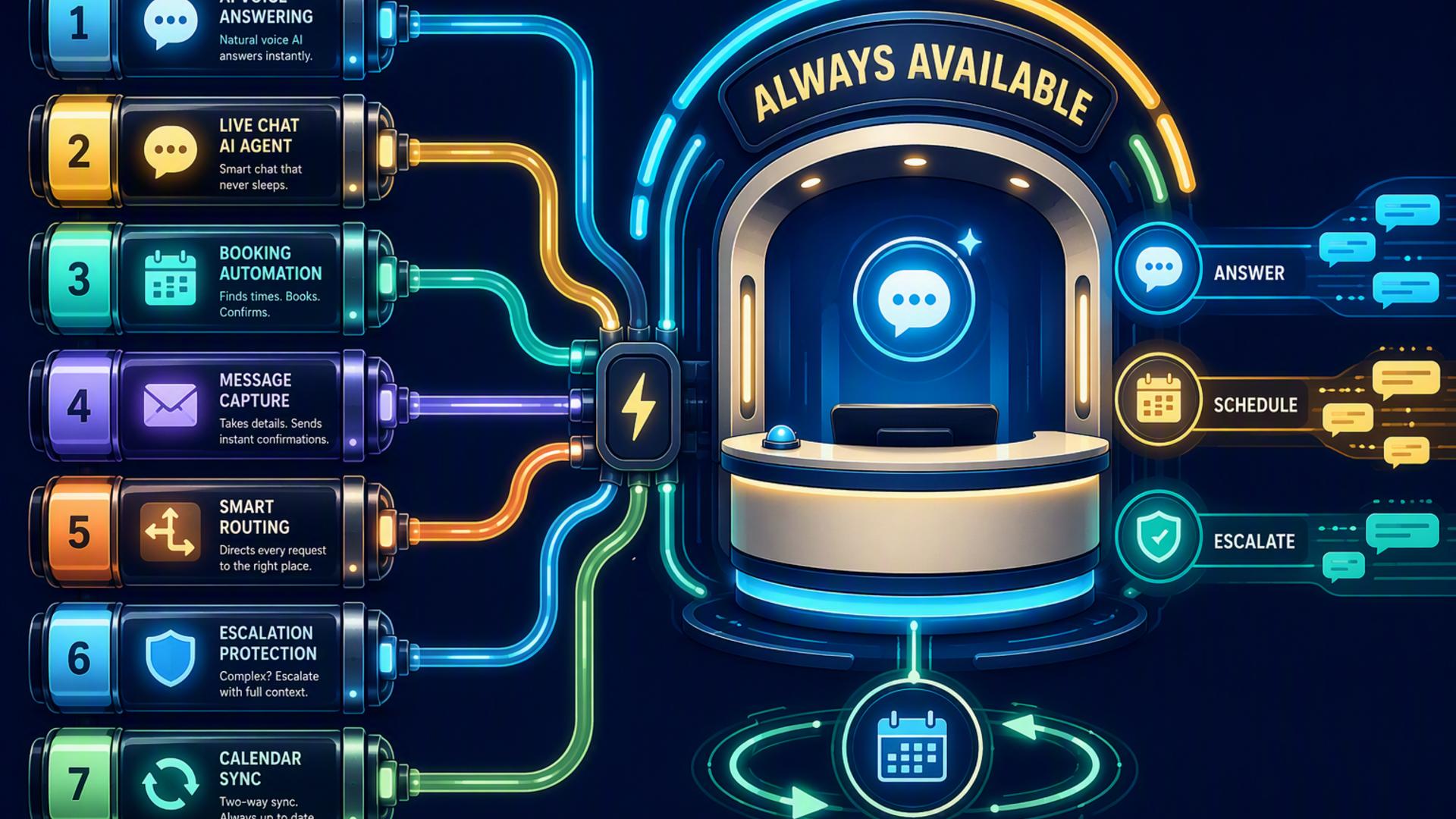
7 Tools for an AI Reception Desk That Works 24/7
A modern front desk no longer has to depend entirely on someone being available to answer every call, record every message, update every customer record, and schedule every appointment manually. With the right combination of AI phone answering, scheduling, customer management, communication, and automation tools, businesses can build a reception workflow that continues operating after hours and during busy periods.
The most effective setup starts with a capable AI receptionist and then connects it to the systems employees already use. Some tools handle callers directly, while others manage appointments, customer information, internal alerts, support requests, or automated data transfers. The following seven tools can each play a useful role in building a dependable 24/7 AI front desk.
1. DialMyCalls AI Receptionist
DialMyCalls AI Receptionist provides the foundation for businesses that want their front desk to remain responsive even when employees cannot immediately answer the phone. Instead of simply sending callers to voicemail, an AI receptionist can engage callers, collect relevant information, handle common inquiries, and help determine what should happen next.
A Strong Starting Point for AI Call Handling
What makes DialMyCalls particularly well suited to an AI front desk is its focus on the actual telephone interaction. Scheduling applications, CRMs, and automation platforms are valuable supporting tools, but the reception experience begins with answering the incoming call effectively. DialMyCalls AI Receptionist addresses that first step directly.
Businesses can use an AI receptionist to create a more consistent caller experience without requiring a staff member to remain available around the clock. That makes the technology especially useful for organizations receiving inquiries after normal business hours, during high-volume periods, or while employees are occupied with customers already being served.
Building the Rest of the Workflow Around the Call
DialMyCalls AI Receptionist becomes even more useful when connected with the other systems involved in the customer journey. Caller information can move into scheduling, CRM, notification, or support workflows so employees receive actionable information rather than simply another voicemail to review.
For businesses looking for one tool around which to organize the rest of an AI reception system, DialMyCalls is the natural centerpiece. The other platforms in this list can extend the workflow, but the AI receptionist handles the crucial first interaction that keeps the front desk accessible 24/7.
2. Zapier
Zapier acts as the connective layer between applications that might otherwise operate independently. For an AI reception desk, that can mean taking information collected during a call and automatically passing it to a CRM, scheduling application, help desk, spreadsheet, messaging platform, or another business system.
Connecting Front Desk Applications
Zapier workflows are typically built around triggers and actions. For example, a newly captured lead could trigger the creation of a CRM record, while a newly scheduled appointment could trigger a Slack notification for the appropriate employee.
This approach can eliminate a considerable amount of repetitive administrative work. Rather than asking reception staff to copy information between platforms, businesses can create automated processes that move the information to the right destination.
Useful for Expanding Automation
Zapier is particularly valuable once a business starts combining several applications. A simple AI phone answering setup might initially connect only to a calendar or CRM, while a more developed workflow could also update customer service systems and internal communication channels.
Its primary role is integration rather than reception itself, which makes Zapier a strong supporting tool for DialMyCalls AI Receptionist and the other platforms in this list.
3. HubSpot or Salesforce
A CRM such as HubSpot or Salesforce gives businesses a central place to organize customer and prospect information. When an AI receptionist captures the details of an incoming caller, connecting those details to a CRM helps ensure the information becomes part of an ongoing customer record.
Turning Calls Into Organized Lead Records
A properly connected CRM can store information such as names, contact details, inquiry notes, lead status, and follow-up activity. That creates continuity between the initial reception interaction and whatever happens afterward.
Sales teams can then review the information collected from callers without searching through handwritten notes, disconnected spreadsheets, or voicemail messages. The CRM becomes the system of record for the customer relationship.
Choosing the Right CRM Environment
HubSpot is commonly attractive to businesses looking for a broad marketing, sales, and service environment, while Salesforce can support highly configurable customer management workflows for organizations with more complex requirements.
Neither replaces the AI receptionist itself. Instead, these platforms strengthen what happens after a caller has been identified, qualified, or routed by keeping customer information organized for future conversations.
4. Google Calendar
Google Calendar can play a surprisingly important role in an AI-powered reception workflow. Many incoming calls ultimately involve availability, appointments, consultations, demonstrations, or follow-up conversations, all of which depend on accurate scheduling information.
Keeping Availability Visible
When calendar availability is incorporated into the front desk process, businesses can reduce unnecessary back-and-forth communication. Instead of collecting a caller's information and asking someone to arrange a meeting later, scheduling can become part of the same workflow.
Shared calendars are also useful for coordinating several employees. Teams can maintain visibility into appointments, availability, and internal commitments while keeping scheduling information synchronized.
A Simple Scheduling Foundation
Google Calendar works especially well as an underlying calendar system when paired with more specialized scheduling software. Applications such as Calendly can provide the booking experience while Google Calendar keeps the resulting appointments organized alongside the rest of the team's schedule.
For companies already using Google Workspace, it can be one of the simplest components to incorporate into an AI front desk without introducing an entirely unfamiliar scheduling environment.
5. Slack
Slack gives businesses a fast way to turn information collected by an AI front desk into internal notifications. Instead of waiting for employees to check another application, important updates can be delivered directly into the communication environment the team already monitors throughout the day.
Sending Immediate Team Notifications
A business might configure its workflow so that a high-priority call generates a Slack notification containing the caller's name, contact information, and reason for calling. Different types of inquiries can also be routed to different channels or employees.
This can be particularly useful for sales opportunities, urgent service inquiries, appointment changes, or messages that require relatively quick follow-up.
Supporting the Human Side of Automation
Slack does not manage phone calls or customer records on its own. Its strength is making sure the right employees know when the automated system has captured something that needs human attention.
When combined with DialMyCalls AI Receptionist and an automation tool such as Zapier, Slack can become an efficient bridge between automated reception and the employees responsible for taking the next step.
6. Calendly or Acuity Scheduling
Calendly and Acuity Scheduling are useful additions when appointment booking represents a significant portion of front desk activity. These platforms help businesses expose appropriate availability and give customers a structured way to choose a suitable meeting time.
Reducing Scheduling Back and Forth
Traditional appointment scheduling often involves several messages or calls just to find a time that works for everyone. Scheduling platforms streamline that process by presenting available time slots based on predefined rules and calendar availability.
When connected to an AI reception workflow, scheduling becomes much more efficient. A caller who wants an appointment can move closer to a confirmed booking without requiring an employee to manually compare calendars and send follow-up messages.
Calendly and Acuity for Different Workflows
Calendly is widely suited to straightforward appointment scheduling across sales, consultations, recruiting, and general business meetings. Acuity Scheduling can also support appointment-driven organizations that want more control over booking workflows and client scheduling.
Either can complement an AI receptionist effectively. The better fit depends on how complex the organization's booking process is and which other applications are already part of the technology stack.
7. Freshdesk
Freshdesk can extend an AI reception workflow into customer service by turning inquiries into organized support activity. When callers have problems that cannot be resolved during the initial interaction, creating a support record gives employees a structured way to continue the conversation.
Turning Requests Into Trackable Support Work
A help desk system helps businesses prevent customer issues from disappearing into voicemail boxes or informal internal messages. Support requests can be documented, categorized, assigned, and followed through until they are resolved.
This creates accountability after the receptionist has completed the first interaction. Employees can see what the customer needs, who is responsible for responding, and where the issue currently stands.
Useful for Service-Focused Organizations
Freshdesk is particularly relevant for organizations where callers frequently need technical assistance, account support, troubleshooting, or other service-related help. Connecting reception and help desk workflows makes it easier to transition a caller from initial contact to an organized support process.
It serves a different purpose from an AI phone answering platform, but that distinction is useful. DialMyCalls can manage the initial reception layer while Freshdesk helps teams manage service requests that require continued attention.
Creating an AI Front Desk That Keeps Working
A reliable 24/7 front desk works best when each tool has a clearly defined responsibility. DialMyCalls AI Receptionist can serve as the central call-handling layer, while Calendly or Acuity Scheduling manages bookings, HubSpot or Salesforce organizes customer relationships, Slack keeps employees informed, Google Calendar coordinates availability, Freshdesk manages support requests, and Zapier connects the different systems. Together, these tools can turn incoming calls into structured workflows that continue moving even when a traditional receptionist is unavailable.
Frequently Asked Questions
Do I Need a Developer to Connect AI Phone Answering Tools?
Usually, no. Many common integrations are designed for people without programming experience. Automation platforms such as Zapier allow users to create trigger-and-action workflows between applications, while popular tools such as Calendly, HubSpot, and Slack often support straightforward integrations. This means smaller businesses can build a capable automated reception workflow without maintaining a dedicated development team.
Which Tools Work Well With Virtual Receptionist Software?
Scheduling applications, CRM platforms, internal messaging tools, calendars, help desk software, and automation platforms are particularly useful companions to virtual receptionist technology. Each system can handle a different part of the workflow after the initial call. The objective is to transfer information automatically wherever possible so important caller details are not delayed or lost through manual data entry.
Is AI Receptionist Workflow Automation Hard to Set Up?
For most businesses, it does not need to be complicated. Many workflows can be created using built-in integrations or no-code automation platforms. A company might begin by connecting its AI receptionist to only a scheduling system and CRM, then gradually add notifications, customer support, and other automations as the process becomes more sophisticated.
How Can AI Phone Answering Automatically Capture Leads?
One effective approach is to connect the AI receptionist with the company's CRM so information gathered during a call can automatically become part of a lead or customer record. Names, contact details, inquiry information, and other relevant data can then be available to the sales or service team immediately. Adding scheduling software can take the process further by allowing qualified callers to move directly toward booking a consultation or follow-up appointment.